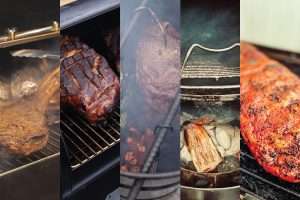
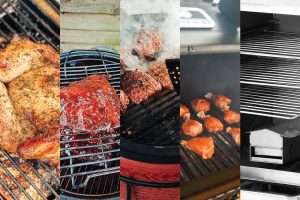
The Kamado Joe Classic I is the entry-level model in the Kamado Joe range, but it is not a stripped-back barbecue in the way some “base models” are.
It still gives you the ceramic body, Divide & Conquer cooking system, heat deflectors, slide-out ash drawer, and enough cooking flexibility to smoke ribs, grill steaks, roast chickens, and cook pizza. What you miss are the more advanced features from the Classic II and Classic III, like the Air Lift hinge, Kontrol Tower top vent, and upgraded gasket.
I’ve cooked on the Kamado Joe Classic I over a period of a few months in different weather conditions, using it for both low and slow smoking and hot grilling. This review is based on what it is actually like to use, not just what the specs say.
Burning Brisket is reader-supported. When you buy through links on our site, we may earn an affiliate commission. Read our affiliate policy to learn more.
Table of Contents
Quick Verdict
The Kamado Joe Classic I is the best choice if you want a proper ceramic kamado without paying extra for the nicer comfort features on the Classic II or Classic III.
It cooks just as well as the more expensive models because the main ceramic body, charcoal cooking style, heat retention, and included smoking setup are all there. The food you turn out on the Classic I can be every bit as good.
Where it feels more basic is in the lid, gasket, and top vent. The lid is heavier to lift, the felt gasket will need replacing sooner than the fiberglass mesh gasket on the upgraded models, and the top vent moves when you open the lid, which is annoying during smoking.
Buy the Kamado Joe i if:
- You want the cheapest Kamado Joe Classic model
- You want real kamado cooking without paying for premium extras
- You mostly cook for a family or small group
- You want to grill, smoke, roast, and cook pizza on one barbecue
Skip The Kamado Joe I if:
- You want the easiest lid to lift
- You’ll be annoyed by the top vent moving
- You regularly cook large briskets or big batches
- You’d rather pay more for the Classic II upgrades
At a Glance
Strengths
- Real ceramic kamado cooking at a lower Kamado Joe price
- Excellent for grilling, smoking, roasting, baking, and pizza
- Includes Divide & Conquer cooking system
- Heat deflectors are included for smoking
- Slide-out ash drawer makes cleanup easier
- AMP firebox helps reduce the chance of cracking
- Very stable once the temperature is dialled in
- Covered by the same strong Kamado Joe warranty
Weaknesses
- Top vent moves when you open the lid
- Standard lid hinge is heavier than the Air Lift hinge on the Classic II
- Felt gasket is not as long-lasting as the upgraded fiberglass mesh gasket
- 18-inch grate is enough for everyday cooking, but not huge
- Whole briskets can be tight depending on size
Best Use Case
The Classic I is best for someone who wants a quality ceramic kamado for backyard cooking, but does not want to pay extra for comfort upgrades. It is a strong choice if you mostly cook for a family or small group and want one barbecue that can handle steaks, ribs, pork shoulder, chicken, and pizza.
What the Kamado Joe Classic I Is Actually Like to Cook On
The Kamado Joe Classic I feels like a proper ceramic kamado, not a cheap “entry-level” barbecue.
That matters because the Classic I is the lowest-priced model in the Kamado Joe Classic range. But, when you’re actually cooking on it, the food doesn’t feel entry-level. You still get the thick ceramic body, the charcoal flavour, the Divide & Conquer setup, and the heat deflectors you need for smoking.
I used the Kamado Joe Classic I over a period of a few months for both grilling and smoking, in different weather conditions. I’ve also cooked on other kamados including the Big Green Egg and Pit Boss K22, so this isn’t just me judging it in isolation.
The short version is this: the Classic I cooks really well. The main compromises are not the food. They’re the lid weight, the felt gasket, and the top vent that moves when you open the dome.

Grilling on the Kamado Joe Classic I
Grilling on the Classic I is straightforward.
Light your lump charcoal, let the ceramic body warm up, set your grates, and cook. Once it is hot, it gets properly hot. Steaks, burgers, sausages, wings, and chicken all make sense on this barbecue.
The tomahawk steaks I cooked on the Classic I turned out really well. I started them over direct high heat to sear the outside, then added the heat deflector, used a MEATER Plus probe to monitor the internal temperature, partially closed the vents, and let the steaks finish more gently.
That is where the kamado setup works so well. You can sear hard over direct heat, then shift into indirect cooking without needing a second barbecue.

The grill marks were exactly what you want from charcoal cooking. But, the heat is not just coming from underneath like a basic grill. Because the lid is ceramic too, it radiates heat back down over the food, so it cooks more evenly than an open grill.
That makes it good for roasting too. Whole chickens are one of my favourite things to cook on the Kamado Joe. The ceramic body gives you that oven-like heat, but with charcoal flavour.
It also turns out decent pizza, even without the DoJoe. The DoJoe makes pizza easier and more fun, especially when people are around, but it is not required just to make pizza on the Classic I.
Smoking on the Kamado Joe Classic I
Smoking on the Kamado Joe Classic I is easy once you get used to the vents.
The heat deflectors are included, which is important. You do not need to buy an extra plate just to set it up for low and slow barbecue. Add the heat deflectors, close the vents down, and let the ceramic do its thing.
Getting it to around 225°F does not take too much practice. The biggest thing is not overshooting your target temperature. Ceramic kamados hold heat so well that if you let the temperature run too high, it takes a while to bring it back down.
For smoking, I usually start with the bottom vent open around 2 inches and then adjust the top vent to fine-tune the temperature.

You can add wood chunks if you want a stronger smoke flavour. But, inside a kamado, a little wood goes a long way.
I actually prefer the full charcoal-smoked flavour on the Kamado Joe Classic I instead of always adding wood. So, don’t assume you need wood chunks to smoke on a KJ. Charcoal alone can give you a really good flavour.
You can also use a pellet smoker tube if you prefer using hardwood pellets instead of chunks.
The main frustration when smoking is the top vent. When you open the lid, the vent can move. That means the setting you carefully found can disappear just because you opened the dome to add meat or check the cook.
I try to look at the vent position before opening the lid, but there are still times I forget and need to reset it.
It is not a deal-breaker, but it is the one thing about the Classic I that feels clearly worse than the Classic II.
Performance Breakdown
Temperature Control
Temperature control on the Classic I is good, but it is still a charcoal kamado. You need to learn how the vents respond.
Open the bottom and top vents more, and the charcoal gets more oxygen so the temperature rises. Close them down, and the temperature drops. Simple enough, but because the ceramic holds heat so well, you do not want to overshoot.
That is probably the main learning curve for beginners. If you are aiming for 225°F and let it climb too high, you cannot just instantly bring it back down. The cooker is holding that heat in the ceramic.
Once you have it settled, though, it is very stable. That is one of the best things about cooking on a kamado. It does not need the same constant fire management as an offset smoker, but you still get that hands-on charcoal cooking feel.
Smoke Flavor
The Classic I gives a proper charcoal-smoked flavour.
It is not the same as a pellet grill. It is stronger, richer, and more charcoal-forward. If you like the flavour from lump charcoal, this is one of the reasons a kamado makes sense.
Wood is optional. You can add chunks for more smoke, but I would start small. A kamado holds smoke well, and too much wood can get heavy fast.
For ribs, pork shoulder, and chicken, I am very happy with the charcoal-only flavour from the Classic I.
If you are still deciding between kamado and offset cooking, Kamado vs offset smokers is a useful comparison before you choose.
Capacity
The Classic I has an 18-inch cooking grate with 254 square inches of standard cooking space.
That does not sound huge, and it is not. But, for everyday cooking, it is enough for a lot of people.
You can cook:
- A few steaks
- Burgers
- Sausages
- Wings
- Whole chickens
- A pork shoulder
- A rack of ribs
- Smaller brisket-style cooks

A rack of ribs fits easily on the Classic I. I’ve also cooked pork shoulder and ribs together on it.
The Divide & Conquer system makes the space more flexible than a basic 18-inch grill. You can set up different heights, use half-moon heat deflectors, and add extra grates if you want more cooking area.
With extra half-moon grates, you can run two full levels and roughly double the cooking space. There is also an optional grill expander that takes the maximum capacity higher again.
But, the diameter is still the diameter. If you regularly cook full briskets or big batches, the Classic I can feel tight. That is when the Big Joe I makes more sense.
Divide & Conquer Cooking System
The Divide & Conquer system is one of the best reasons to buy Kamado Joe over a more basic kamado.
Instead of having one fixed grate level, you can set half-moon grates and heat deflectors at different heights. That gives you more control over how you cook.
For example, you can have one side set up for direct heat and the other side set up with a heat deflector. That lets you sear steak close to the fire while cooking sides more gently on indirect heat.
It also helps with capacity because you are not stuck using one flat grate. You can build up, split the heat zones, and make the most of the 18-inch cooker.
For a smaller kamado, that flexibility matters.

Build Quality
The Classic I feels solid and well made.
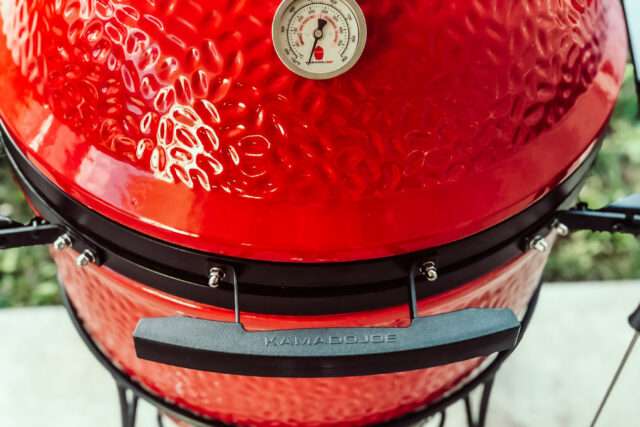
The ceramic body is thick and heavy. It holds heat well and does not feel overly affected by a bit of bad weather. The porcelain-glazed exterior also gives it that durable kamado feel.
The AMP firebox is one of the smartest parts of the design.
A lot of kamado fireboxes are one-piece, and because they sit around such intense heat, they can crack. Kamado Joe’s AMP firebox is split into five removable panels, giving the pieces room to expand and contract instead of putting all that stress into one solid firebox.

The grates are stainless steel, so they are easy to clean and should last well.
The side tables are metal too, which I like. A lot of kamados at this sort of price use cheaper-feeling side shelves. The metal side tables feel more practical when you are working around hot food and tools.
The stand is solid once everything is assembled. The base is welded and powder-coated, but the top ring around the body is screwed into place. It does not look like the strongest design when you are putting it together, but once the kamado is sitting in there, it holds properly and does not feel like a problem.
Lid, Hinge, and Gasket
This is where the Classic I feels more basic than the Classic II.
The lid is heavy. The standard spring-loaded hinge works, and I do not have any complaint about the quality, but it does not compare to the Air Lift hinge on the Classic II and Classic III.
If you are used to the upgraded hinge, the Classic I lid feels like more effort.
The gasket is also felt, not the fiberglass mesh gasket used on the more expensive models. It still seals well enough to cook properly, and it is similar to what you see on a lot of other kamados. But, it will need replacing sooner than the upgraded gasket.

These things do not stop the Classic I from cooking well. They just make it feel like the entry-level model in daily use.
Top Vent
The top vent is my biggest complaint with the Kamado Joe Classic I.
It controls airflow fine. The issue is that it moves when you open the lid.
That is annoying for grilling, but it is more frustrating when smoking. If you have spent time getting the vent set just right for 225°F, then open the dome and lose that setting, you have to adjust it again.

The Classic II’s Kontrol Tower top vent is better. It stays in place when you open the lid and also blocks rain and wind better.
Most of the time, I grill undercover, so weather has not been a big issue for me. But, if your kamado will sit somewhere exposed, this is one of the reasons the Classic II could be worth paying more for.
Fuel Use
The Classic I is efficient with charcoal.
Because the ceramic body holds heat so well, you are not constantly burning through fuel once it is settled. A full load of quality charcoal should give you a long smoke, depending on how much you load and what temperature you are running.
Kamado Joe Big Block charcoal is ideal because it is low ash, which helps keep airflow cleaner during longer cooks.
For normal grilling, you do not need a huge amount of charcoal. For smoking, load it properly at the start and you should not need to keep topping it up during an average cook.
I have listed my favorite lump charcoals for kamado cooking in the Best Lump Charcoal round-up if you want to see the top brands.
Cleaning
The Classic I is one of the easier charcoal barbecues to clean.
After cooking, scrape the grates down. Once the ash is cool, pull out the slide-out ash tray and empty it.
That slide-out ash tray is a really useful feature. It is much easier than scooping ash out from the bottom of the cooker.
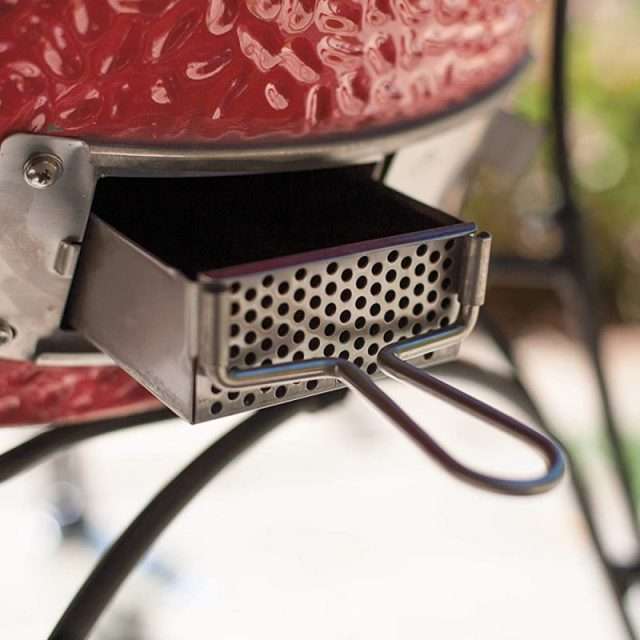
Depending on how often you use it, you will still want to do a deeper clean once or twice a year. But, day-to-day cleanup is simple.
Setting Up and Moving It
The Classic I is heavy. If you can get it delivered, do that.
It comes packed really well, with the stand, firebox pieces, and accessories all protected. There are not a lot of parts, so setup is not complicated, but lifting the ceramic body is the hard part.

You need at least two people to safely lift it out of the packaging and into the stand.
The AMP firebox is also easier with an extra set of hands. There are five firebox panels that need to be arranged inside the cooker and slotted into the metal ring. It is not hard, just a bit fiddly by yourself.
Once it is assembled, this is not a barbecue you want to move around unnecessarily.
Meat Thermometer Use
I would still use a separate meat thermometer with the Classic I.
The built-in dome thermometer is useful for giving you a general idea of the cooker temperature, but the temperature at grate level can be different from what the dome is showing.
For steaks, I used a MEATER Plus probe so I could watch the internal temperature while finishing them indirectly. That is especially useful on a kamado because it is very easy to overcook expensive meat if you are just guessing.
For smoking, a probe thermometer also makes long cooks easier. You can monitor the meat without opening the lid too often, which helps keep the temperature more stable.
Classic I vs Classic II: Which One Should You Buy?
The Classic I and Classic II both turn out really good food.
That is the important point. You are not paying more for the Classic II because it magically cooks better ribs or steaks. You are paying for a few upgrades and easier day-to-day use.
The Classic II gives you:
- Kontrol Tower top vent
- Air Lift hinge
- Fiberglass mesh gasket
- Stainless steel latch
- Same core kamado cooking style
The Air Lift hinge makes the heavy ceramic lid much easier to open. The Kontrol Tower top vent is also a real upgrade because it stays in place better and gives more weather protection.
If your budget is tight, the Classic I is still the better value because the cooking results are there.
If you know the heavy lid and moving top vent will annoy you, the Classic II is worth the extra money.
For a full side-by-side, read my Kamado Joe Classic I vs Classic II comparison.
Classic I vs Big Joe I: Is the Bigger Size Worth It?
The Classic I is enough for a lot of backyard cooks.
If you mostly cook for your family, do steaks, sausages, wings, chicken, ribs, pork shoulder, and pizza, the 18-inch size works well.
The Big Joe I is better if space is your main concern. The 24-inch grate gives you much more room, especially for whole briskets and larger cooks.
You can expand the Classic I with extra grates and the Divide & Conquer system, but you cannot change the basic width of the cooker.
If you only cook big occasionally, the Classic I is fine. If you know briskets, big family gatherings, or batch cooking are going to be regular, I would look at the Big Joe I from the start.
What to Expect From the Kamado Joe Classic I
The Classic I is a proper ceramic kamado, but it is still the entry-level model.
Expect:
- A bit of a learning curve with the vents
- Very stable heat once it is dialled in
- Strong charcoal flavour
- Good low and slow smoking without much babysitting
- Proper high-heat grilling
- A heavy ceramic lid
- A top vent that can move when you open the dome
- Enough space for family cooking, but not huge cooks
- Easy ash cleanup
- Good accessory options if you want to expand later
Do not expect pellet grill convenience. You are still lighting charcoal and managing airflow.
But, also do not expect it to feel cheap. The Classic I feels like a simpler Kamado Joe, not a low-quality one.
Pros and Cons
Pros
- Real ceramic kamado cooking at the lowest Kamado Joe Classic price
- Excellent for grilling, smoking, roasting, baking, and pizza
- Holds heat really well
- Divide & Conquer system is included
- Heat deflectors are included for smoking
- AMP firebox is a smart long-term design
- Slide-out ash drawer makes cleanup easier
- Charcoal flavour is really good even without added wood
- Strong warranty
Cons
- Top vent moves when you open the lid
- Lid is heavy compared with the Classic II
- Felt gasket will need replacing eventually
- 18-inch grate can feel tight for large cooks
- Whole briskets may be awkward depending on size
- You need to avoid overshooting your target temperature
Who This Is For (and Not For)
The Kamado Joe Classic I Is Best for:
- People who want the cheapest Kamado Joe Classic model
- Backyard cooks who want real kamado cooking
- Families or small groups
- Anyone who wants to grill and smoke on one barbecue
- Buyers who care more about cooking results than premium features
Who should skip the Kamado Joe Classic I:
- Anyone who wants the easiest lid to lift
- People who smoke often and will hate the moving top vent
- Buyers who regularly cook large briskets
- Anyone who needs more space for big groups
- People who would rather pay extra for the Classic II upgrades
Alternatives to Consider
The Kamado Joe Classic I is fantastic entry into kamado cooking buy. But, there are times where it may be worth spending a little more now to buy a barbecue that’s a better fit long-term.
Kamado Joe Classic II

The Classic II is the one to look at if you like the Classic I but want a few useful upgrades.
With an air lift hinge, longer-lasting gasket, and sturdier top vent, it doesn’t make better food but gives higher-end features.
If you’re trying to keep the price down, the Classic I still gives you the core cooking experience.
Kamado Joe Big Joe I

The Big Joe I is the better choice if the Classic I sounds good, but too small.
The wider 24-inch grate gives you more room for briskets, larger roasts, and cooking for a group.
If you mostly cook for family, the Classic I is enough. If big cooks are normal for you, go Big Joe.
Big Green Egg
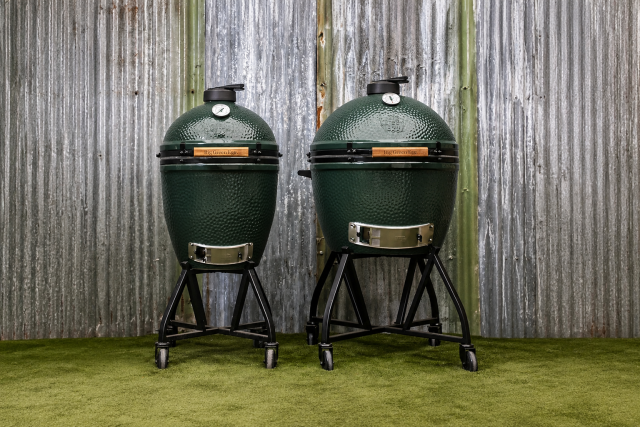
The Big Green Egg is the obvious comparison because it is still the best-known kamado brand.
I still lean toward the Classic I for most buyers because Kamado Joe includes more useful gear in the package.
The Big Green Egg is worth considering if you specifically want one, but the Classic I makes more practical sense to me.
FAQs
Is the Kamado Joe Classic I big enough?
For family cooking and small groups, yes. The 18-inch grate is enough for steaks, burgers, chicken, ribs, pork shoulder, wings, and pizza.
It is not the best choice if you regularly cook large briskets or big batches of food.
Can you smoke on the Kamado Joe Classic I?
Yes. The Classic I comes with heat deflectors, so you can set it up for indirect smoking straight away.
Once you get used to the vents, it holds smoking temperatures well and does not need much babysitting.
What is the main downside of the Kamado Joe Classic I?
The top vent moves when you open the lid.
It is not a huge issue for quick grilling, but it is annoying during smoking because you can lose your vent setting.
Is the Kamado Joe Classic II worth the upgrade?
It can be, but mostly for convenience.
The Classic II gives you the Air Lift hinge, Kontrol Tower top vent, fiberglass mesh gasket, and latch. The cooking results should be similar, but the Classic II is easier to use.
Can you cook pizza on the Kamado Joe Classic I?
Yes. The Classic I can cook good pizza, even without the DoJoe.
The DoJoe makes pizza easier because you can slide pizzas in and out without opening the whole dome, but it is not essential.
Do you need wood chunks to smoke on the Kamado Joe Classic I?
No. You can add wood chunks, but you do not have to.
I often prefer the charcoal-smoked flavour without adding wood. If you do add wood, start with a small amount because smoke builds quickly inside a kamado.
Final Verdict
The Kamado Joe Classic I is the best fit if you want a proper ceramic kamado without paying for the Classic II’s comfort upgrades.
It still grills beautifully, smokes well, holds heat efficiently, and comes with the main accessories you need to start cooking properly. The food is not the compromise.
The compromise is in the day-to-day feel. The lid is heavier, the gasket is more basic, and the top vent moving when you open the lid is annoying.
If those things do not bother you, the Classic I is a very strong entry-level Kamado Joe. If they do, the Classic II is the cleaner upgrade.

Jared Brown is a barbecue enthusiast with hands-on experience across a wide range of grills, smokers, and outdoor cooking setups. He enjoys testing different styles of barbecue and helping readers choose equipment that suits the way they actually want to cook, rather than chasing a one-size-fits-all answer. His practical, open-minded approach makes him a trusted voice for backyard cooks looking for honest guidance and better results.